Conservation work protects rare 1,500-year-old synagogue mosaic in northern Israel
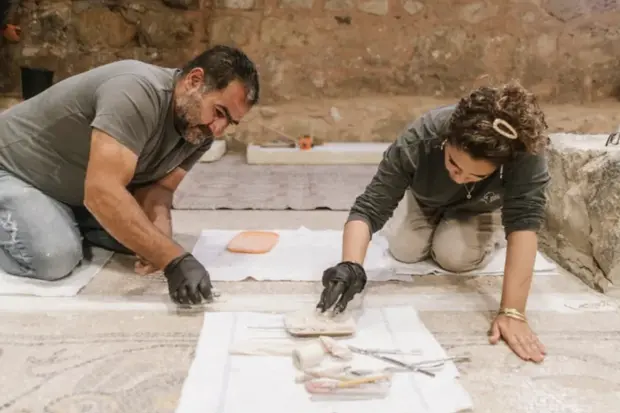
Conservation specialists from the Israel Nature and Parks Authority (INPA) carried out preservation work this week on the rare, 1,500-year-old mosaic floor of the ancient synagogue at Beit Alfa National Park in northern Israel.
The effort brought together more than a dozen specialists from across the country to protect one of the region’s most remarkable examples of ancient Jewish art.
The conservation work focused on gently cleaning the mosaic’s surface, stabilizing loose stones and reinforcing areas in need of repair.
Specialists also carried out a process known as “repointing,” in which gaps between loose stones are refilled with mortar similar to the original material used to construct the mosaic.
“More than 800,000 tiny mosaic stones, laid side by side approximately 1,500 years ago, come together to tell a fascinating story about the people who lived here and the artists who created this extraordinary work,” said INPA Archaeology and Heritage Division Director Orit Bortnik. “Our responsibility is to preserve this mosaic so that future generations can be moved by it just as we are.”
The synagogue mosaic is famous for its unusual combination of Jewish and Greco-Roman imagery. It depicts the Ark of the Covenant and the Binding of Isaac, alongside the Greek sun god Helios driving his chariot across the sky. Helios is surrounded by the 12 signs of the Zodiac, with four female figures representing the seasons placed in a square frame around the central scene.
Inscriptions in ancient Greek identify the mosaic’s artists as Marianus and his son Hanina. Another inscription, written in Aramaic, says the synagogue was built during the “reign of Justinian,” which scholars believe refers to Byzantine Emperor Justinian I, who ruled from 527 to 565 A.D.
The mosaic was first uncovered in 1928 by Professor Eleazar Lipa Sukenik, an archaeologist from the Hebrew University of Jerusalem. Sukenik’s son, Yigael Yadin, also became a prominent archaeologist, making several significant discoveries while also serving as the second chief of staff of the Israel Defense Forces.
Archaeologists have uncovered the remains of at least eight synagogues in the region dating to the Byzantine period, between the fourth and sixth centuries A.D., that contain mosaics depicting the Zodiac. Scholars have long debated the meaning of these images and how they fit within Jewish religious life.
The Jewish historian Josephus also addressed the symbolism of the 12 stones on the breastplate of the high priest during the Second Temple period, noting that some compared them to the 12 signs of the Greek Zodiac. He wrote that "whether one would prefer to read in them the months or the constellations of like number, which the Greeks call the circle of the zodiac, he will not mistake the lawgiver's intention."
Popular article:

interview Easter message of resurrection hope amid war at Jerusalem's Garden Tomb

biblical commentary Let my people go: a Passover message for today

4 IDF soldiers killed, 2 wounded in fighting in southern Lebanon, as Israel eliminates dozens of Hezbollah terrorists

Receive latest news & updates
A message from All Israel News
Help us educate Christians on a daily basis about what is happening in Israel & the Middle East and why it matters.
For as little as $10, you can support ALL ISRAEL NEWS, a non-profit media organization that is supported by readers like you.
Latest articles:

Following reported explosions on 3 ships in Strait of Hormuz, IRGC threatens vessels operating outside Iranian route
Irish Jews, Israel condemn Albanese’s 'unhinged' accusations against Israel

Iran’s IRGC signals plans for missiles beyond 2,000 km, vows to 'demonstrate' capabilities

President Herzog gives mandate for forming next government to Eisenkot
Holocaust survivor returns to Berlin on Kristallnacht anniversary, urges Germany to fight antisemitism